What a furnace tune-up covers before a New Jersey winter
A local pro who services furnaces gets in touch about the tune-up.
A tune-up before winter is the one visit that tells you whether your furnace is ready for New Jersey cold or waiting to fail on the coldest night. A technician checks the igniter, tests the flame sensor, looks at the heat exchanger for cracks, and checks the gas pressure. Each of those matters on its own, and together they decide whether your furnace runs clean and lights every time it's asked to.
Gas is how most homes here heat, and electricity to run a furnace that's straining costs more in a state where power already runs high. A furnace with a dirty flame sensor or a clogged filter works harder to do the same job, and that shows up on the bill before it shows up as a breakdown.
You don't have to know which part is worn or what it should cost to fix. That's the point of asking now, before the first real cold snap, instead of after the blower stops on a Tuesday night in January. Once you send the request, the job of finding someone becomes someone else's. You're matched with a contractor who works on furnaces like yours, in towns like yours, and they're the one who reaches out to you.
That's a different thing than searching contractor listings yourself, calling around, and hoping someone has an opening before the weather turns. It's one step, and it's off your plate.
Below, you'll find what an actual tune-up covers, part by part, so you know what to expect and what counts as done right. Read through it, then use the form when you're ready to have someone look at your system before the cold sets in for good.
A furnace tune-up before winter covers the parts that wear out quietly and the ones that fail dangerously. A technician cleans or tests the igniter and flame sensor, since a weak one of either leaves you with cold air and a furnace that won't stay lit. The heat exchanger gets checked for cracks, because a cracked one can leak carbon monoxide into the house. Gas pressure gets measured, the burners get checked for even flame, and the blower and filter get looked at so air actually moves through your ducts. In New Jersey, most homes run on gas heat straight through the cold months, and a furnace that starts the season with a dirty flame sensor or a weak igniter is the one that quits on the night it's twenty degrees outside. Catching that in October instead of January is the point of the visit.
Clean burn, tight connections, ductwork that still carries full airflow to every room.
Rust on the cabinet, staining on the floor below, and pipes old enough to leak before spring.
Is your furnace actually ready for this winter
You've probably run the furnace for a few minutes here and there since spring, just to check it still comes on. That's not the same as it holding up through a run of nights in the 20s. Listen for a bang or rattle when it starts up, or a burner that smells off for more than a few seconds. Look at the flame through the viewing window. It should be steady blue, not yellow or flickering. Check the vents in each room, since a weak one or a cold spot in a bedroom usually means a duct problem or a filter that's been ignored too long. If the furnace hasn't been looked at since last winter, a crack or a stuck valve can go unnoticed until the night you need the heat most.
You're down in the basement on a Saturday afternoon, the light through the small window already going thin and yellow. The furnace has been running on and off since you bumped the thermostat down this morning, and you've pulled the filter to check it before the cold really sets in. It's grey, matted with a season of dust, the pleats barely visible anymore. You hold it up to the bulb overhead and can't see light through half of it. The blower hums behind you, pulling air through whatever's left of the airflow. You set it on the concrete floor and stand there a second, thinking about the nights coming in the 20s, and whether this is the only thing you'd have missed.
New Jersey's power rates are among the highest in the country, so a furnace losing efficiency costs you more here than it would almost anywhere else. A dirty burner or a clogged filter makes the furnace run longer to reach the same temperature, and that shows up on the bill before it shows up as a breakdown. A tune-up catches that drift early, while the parts are still cheap to adjust instead of expensive to replace. You don't need to know whether what you're hearing or smelling down there is normal. That's the point of having someone else check it. Once you send the request, the search for who to call is off your plate, and whatever your furnace needs before the cold nights settle in, it gets found and fixed by someone who does this for a living, not by you guessing in the basement with the manual.
A furnace's heat exchanger is a sealed metal chamber that separates the combustion gases from the air blown through your house. A crack in it lets those gases mix with that air.
That's why a tune-up includes a check of the exchanger and often a carbon monoxide test at the furnace itself, not just a look at the thermostat reading.
Before you get your furnace maintenanceAfter you get your furnace maintenance
A furnace kept up
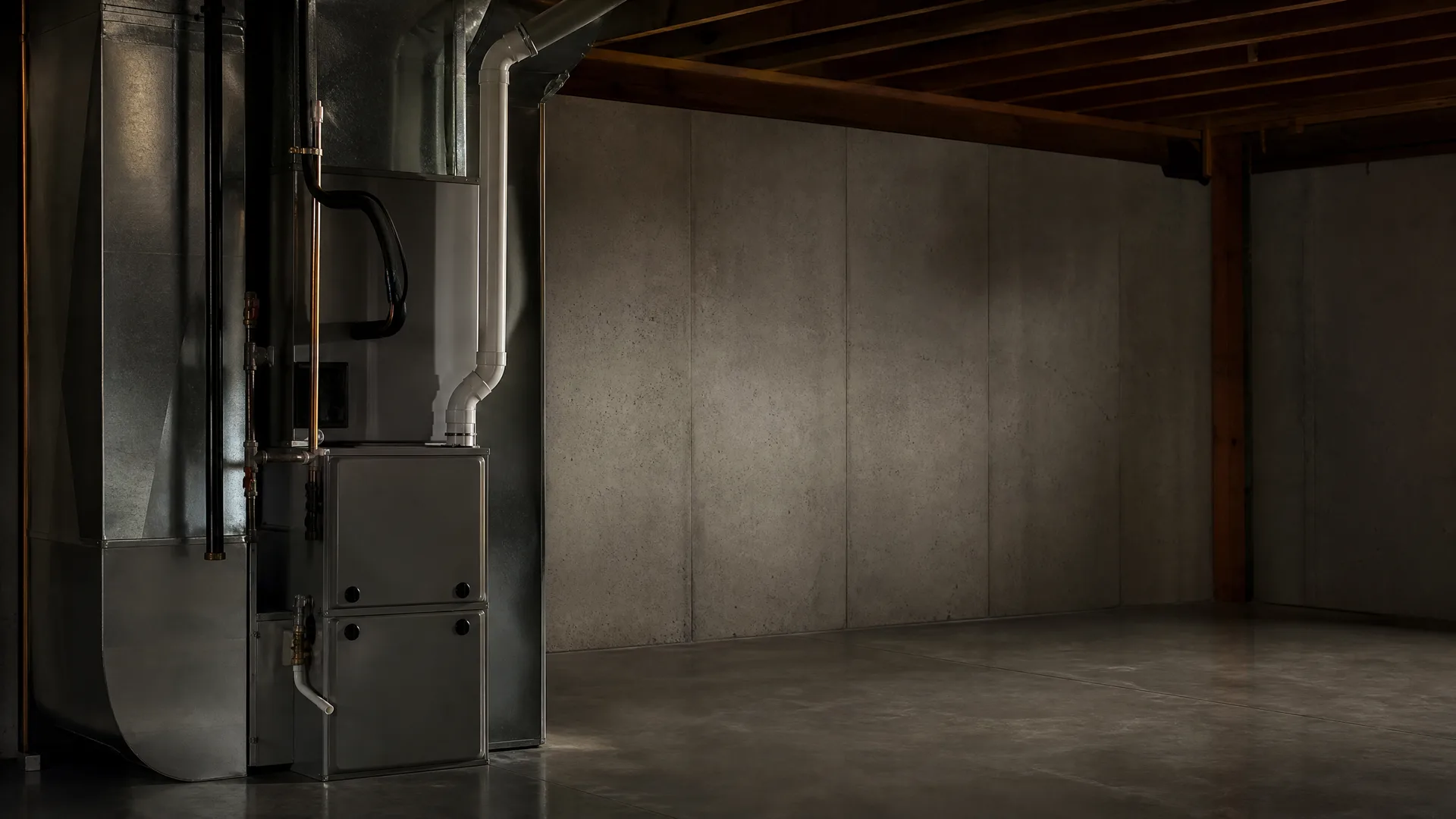
This one's new enough that the ductwork and gas lines still look factory-clean. A tune-up on a furnace like this is quick work: check the igniter, confirm the flame sensor reads right, make sure the PVC venting is sealed. Nothing to chase, just confirming it's ready for the cold.
A furnace left alone
Dust on the cabinet like this builds up over years of filters changed late or skipped. A tune-up here is less routine and more inspection: the technician is looking for what that neglect did to the burners, the exchanger, the connections. Older copper gas lines get a closer look too.
Winter nights average 26°F statewide
At 26°F, your furnace isn't cycling on and off a few times a night. It's running long stretches to hold the house steady until morning. A furnace that's behind on maintenance has to work harder to do that, and it shows up on the gas bill before it shows up as a breakdown.
NOAA nClimDiv 1991-2020 county normals weighted by homes
Skip It or Get It Done
Skip the tune-up
The igniter or flame sensor can fail mid-cycle on a cold night instead of during a scheduled check.
A dirty burner or clogged filter makes the furnace run longer to hit the same temperature, and that shows up on your gas bill.
A cracked heat exchanger can go unnoticed until carbon monoxide is already mixing with the air moving through your house.
Rust or staining near the cabinet keeps spreading quietly until a pipe fails outright.
You find out whether the furnace holds up on the first real cold snap, not before it.
Get it tuned up
A technician tests the igniter and flame sensor before either one leaves you with cold air.
The heat exchanger gets checked for cracks, often along with a carbon monoxide check.
Ductwork gets looked at to confirm it still carries full airflow to every room.
Clean burners and tight connections mean the furnace isn't working harder than it has to on New Jersey's expensive power.
Problems with PVC venting or gas connections get caught while they're still simple to fix.
New Jersey winter nights average 26°F statewide, according to NOAA climate data. That's cold enough that your furnace runs in long stretches rather than short bursts, often holding steady from the time you go to bed until morning. A furnace that's low on airflow or burning dirty has to push harder to keep up with that kind of run, and the strain shows up first as uneven heat between rooms, then as a furnace that takes longer to recover after the thermostat drops. Some nights dip well below that average, and those are the nights a weak igniter or a cracked exchanger tends to show itself. A tune-up before the cold sets in is what catches that ahead of time, while the furnace is still idling through mild afternoons instead of working through a 26-degree night.
NOAA nClimDiv 1991-2020 county normals weighted by homes
A furnace that's checked once is one less thing to worry about all winter
A tune-up before the cold sets in comes down to the same handful of things: the igniter and flame sensor working right, the heat exchanger free of cracks, the burner clean, the filter clear, airflow reaching every room. Nothing exotic. Just a furnace confirmed to do what it's supposed to do on a night in the 20s instead of guessing.
If you'd rather not track down who's reliable and who just answers the phone fast, that part can be handed off too. Fill out the form and a contractor who handles this in your area will reach out to you directly, matched to what your furnace actually needs. One less call to make, one less name to vet, before the first real cold night gets here.
Matched to your furnace job
One request and finding someone for the tune-up is handled.