Profile view of a bearded man wearing a dark green baseball cap and a dark gray T-shirt against a plain light background.

Signs of a cracked heat exchanger in New Jersey

Step 1 of 3: Equipment

A cracked heat exchanger shows up first as a smell. A sharp, formaldehyde-like odor when the furnace kicks on, headaches or nausea that ease when you leave the house, soot around the furnace cabinet, or a yellow flame instead of a steady blue one. Your furnace might also shut off on its own partway through a cycle. The crack forms from years of the metal heating and cooling, expanding and contracting every time the burner fires, until it finally gives. In New Jersey homes, where gas furnaces run hard from fall through early spring, that metal gets a lot of cycles. A cracked exchanger lets carbon monoxide mix into the air your furnace blows through the house, which is why any of these signs means the furnace should be shut off and looked at, not watched for a while to see if it gets worse.

A smiling man in a gray long-sleeved shirt stands in a kitchen looking to the side, with open shelves of dishes, a white mug on the counter, a potted plant, and a view through a doorway into a living room.
A smiling bearded man in a green sweater sits at a white marble kitchen island with a mug, potted plant and bowl of fruit, in a bright white interior with open shelving and an arched doorway.
A smiling man with dark curly hair and a beard, wearing a dark green knit sweater, stands at a white marble kitchen counter with a dark blue mug, with open shelving, pendant lights and a houseplant behind him.
A smiling man in a green ribbed sweater stands behind a wooden table holding a ceramic mug of coffee in a kitchen with white subway tile, shelves of potted plants, and a bowl of fruit.

Why the crack changes the flame

A heat exchanger is a sealed metal chamber. The burner fires inside it, and the air your blower pushes through your ducts flows around the outside of it, never touching the flame directly. Once a crack opens, it changes the airflow the burner depends on to burn correctly. That is why a cracked exchanger often shows up as a yellow, wavering flame instead of a steady blue one, and why soot starts collecting around the cabinet. The flame is reacting to a chamber that no longer holds air the way it did when the furnace was installed.

The furnace may still try to run

Some furnaces have a flame sensor or pressure switch that shuts the system down when it detects a problem, but not every crack trips a safety switch right away. A furnace can keep running for weeks with a cracked exchanger, cycling heat through your house while carbon monoxide leaks into the air your blower is moving. That gap, between the crack forming and a safety control catching it, is why the smell and the headaches matter as much as any warning light on the furnace itself. By the time a switch trips, the crack has usually been there a while.

A man in a blue T-shirt sits on a light gray sofa, laughing while looking at an open laptop in the foreground, with a framed picture, lamp and potted plant behind him.
A bearded man in a blue and brown plaid flannel shirt stands indoors looking out a window at snow-covered trees, with a ceramic mug on the windowsill.

Catching it on your own

Some of this you can see for yourself. A yellow flame instead of blue, soot stains on the cabinet, rust or a hairline split where the exchanger is visible, a smell when the burner fires. If you notice one of these early, before anyone's gotten sick, you've caught it the same way you'd catch a slow leak under a sink. The trouble is that a crack can also open with no visible sign at all, and by the time the smell is strong enough to notice, the furnace has likely been running that way for a while.


Why this one needs a gauge

Carbon monoxide has no smell and no color, so there's nothing to notice until a detector sounds or someone in the house gets a headache that won't go away. A contractor checks for a crack with a combustion analyzer and a camera, not a glance at the flame. That's the difference between this and most of the small problems you'd normally watch and wait on. A furnace that might be venting exhaust into your living room isn't one to keep running while you decide.

Winter nights average 26°F statewide

At 26°F, your furnace is firing most of the night, every night, all winter. That's more hours for a crack to open and more hours of exhaust working its way into the air your blower moves through the house.

NOAA nClimDiv 1991-2020 county normals weighted by homes

What a technician checks beyond the flame

  • A carbon monoxide detector near the furnace will trip before you smell or see anything wrong with the flame.
  • A furnace that short cycles, shutting off a few minutes after starting, can mean a flame sensor reacting to the crack itself.
  • The blower running longer than usual to reach the same temperature points to heat escaping the exchanger instead of the ducts.
  • Condensation or standing water near the furnace base can mean flue gas condensing inside a cracked chamber instead of venting out.
  • A technician checks for a crack with a combustion analyzer and a camera, not just a visual look at the cabinet.
  • Furnaces installed with the house are the ones most likely to have a worn exchanger, since metal fatigues with every heating cycle.

A cracked heat exchanger does not always announce itself at the cabinet. Some of the clearest signs show up elsewhere in the house. A carbon monoxide detector mounted near the furnace is built to catch the gas before it reaches a level you could smell, so an alarm there means more than a musty basement. Inside the furnace itself, the crack can throw off the flame sensor, and a unit that shuts down a few minutes after it starts is often reacting to that, not to a dirty sensor or a dying igniter. Run time matters too. If the blower seems to run longer than it used to just to hold the same temperature, warm air is escaping through the crack instead of moving through your ducts, and the furnace is working harder to make up for it. Flue gas carries moisture, and once a chamber cracks, some of that gas can condense inside it rather than vent up through the flue, which is why water pooling near the furnace base is worth checking rather than wiping up and forgetting. None of these are things a homeowner can confirm alone. A technician uses a combustion analyzer to read what's actually in the air coming off the burner and a camera to look inside the chamber itself, since a crack can sit somewhere a flashlight never reaches. Furnaces that came with the house are worth watching closest. Metal fatigues a little with every cycle it fires, year after year, and a system that's been cycling on its own clock the longest has had the most chances to develop one.

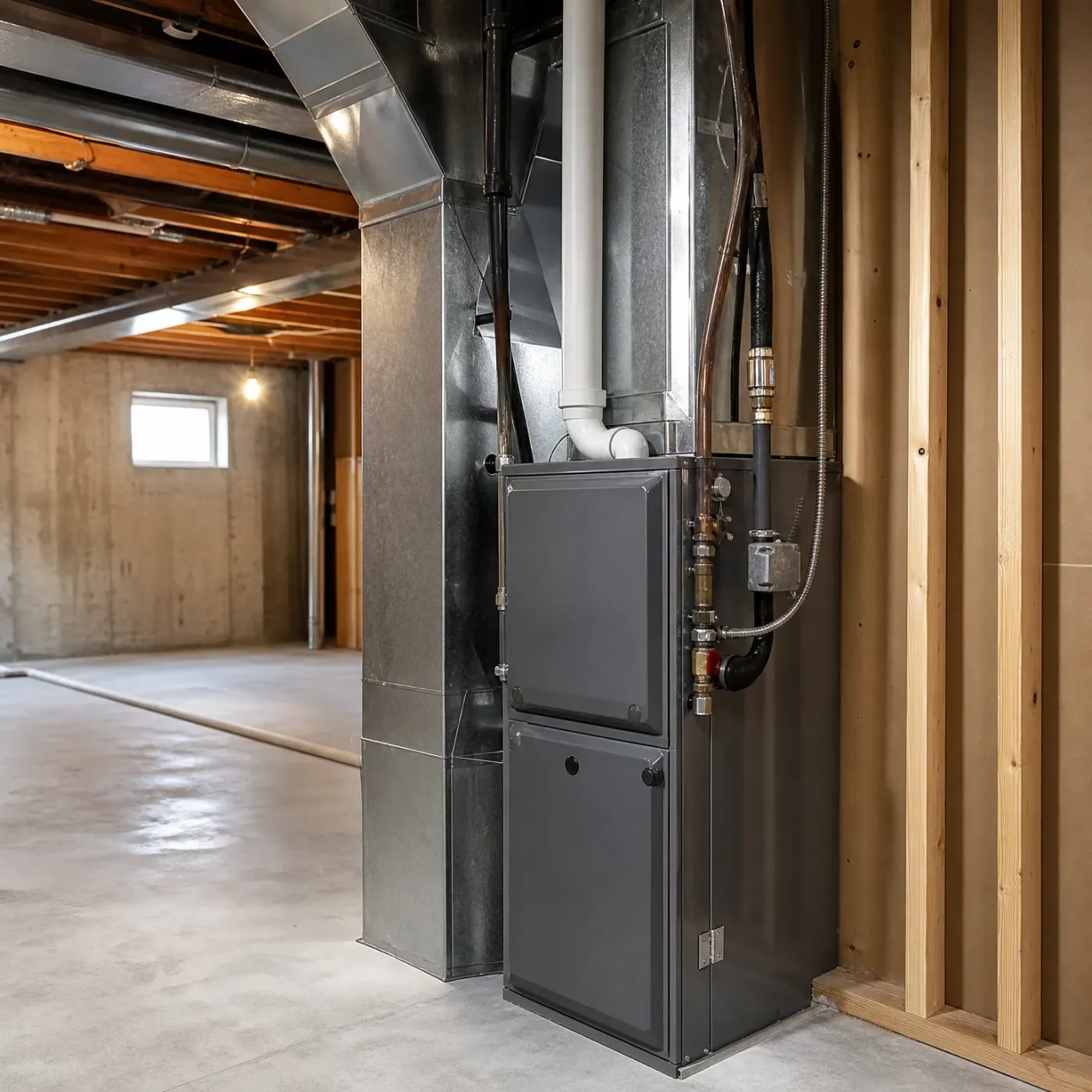
A beige high-efficiency furnace stands on a concrete basement floor beside sheet-metal ductwork, with white PVC vent pipes and a gas line running along an insulated wood-framed wall.
A furnace venting correctly has a steady blue flame and no odor when the burner fires, cycling on and off on its own schedule.
An older metal furnace with a louvered front panel stands against a concrete basement wall, connected to sheet-metal ductwork and a flue pipe, with copper and steel pipes running alongside.
A furnace with a cracked exchanger often looks fine from across the basement, which is why the smell and the flame color matter more than the cabinet's age.
  1. The burner fires inside the sealed metal exchanger chamber.

  2. Heat passes through the metal wall into the air stream.

  3. A crack lets exhaust mix into that air stream instead.

  4. The blower pushes that mixed air through your ducts and vents.

A beige gas furnace in a basement with a metal flue pipe, galvanized sheet-metal ductwork to its left, and gas and water pipes along the concrete wall to its right.
Before you get your furnace repair
A gray high-efficiency furnace with white PVC vent pipes stands on a concrete pad in a basement, beside sheet-metal ductwork, copper piping and a poured concrete wall with wood framing at left.
After you get your furnace repair
A gray furnace with copper and flexible piping stands against a wood-framed wall in an unfinished basement, connected to galvanized sheet-metal ductwork and PVC venting, with a concrete floor and exposed joists.

One request and it's handed off

One form replaces the calls you'd make to find a furnace pro.

Once you send the form, finding a pro is off your list.

Hand it over

It costs nothing to send, and you don't have to hire anyone.

Why does my house smell different when the furnace runs

You might notice it most in the room right above the furnace, or near a floor vent in the basement. A smell that isn't there when the furnace is off. Some households notice a headache that lifts once they're outside or at work, then comes back that evening when the heat kicks on again. You might see soot dusted on the inside of the cabinet door, or notice the flame looks more orange than blue when you glance at it through the viewing window. None of this is something to live with through a New Jersey winter. A furnace that runs most nights from November to March is a furnace with a lot of hours for a crack to do its work on the air moving through your ducts.

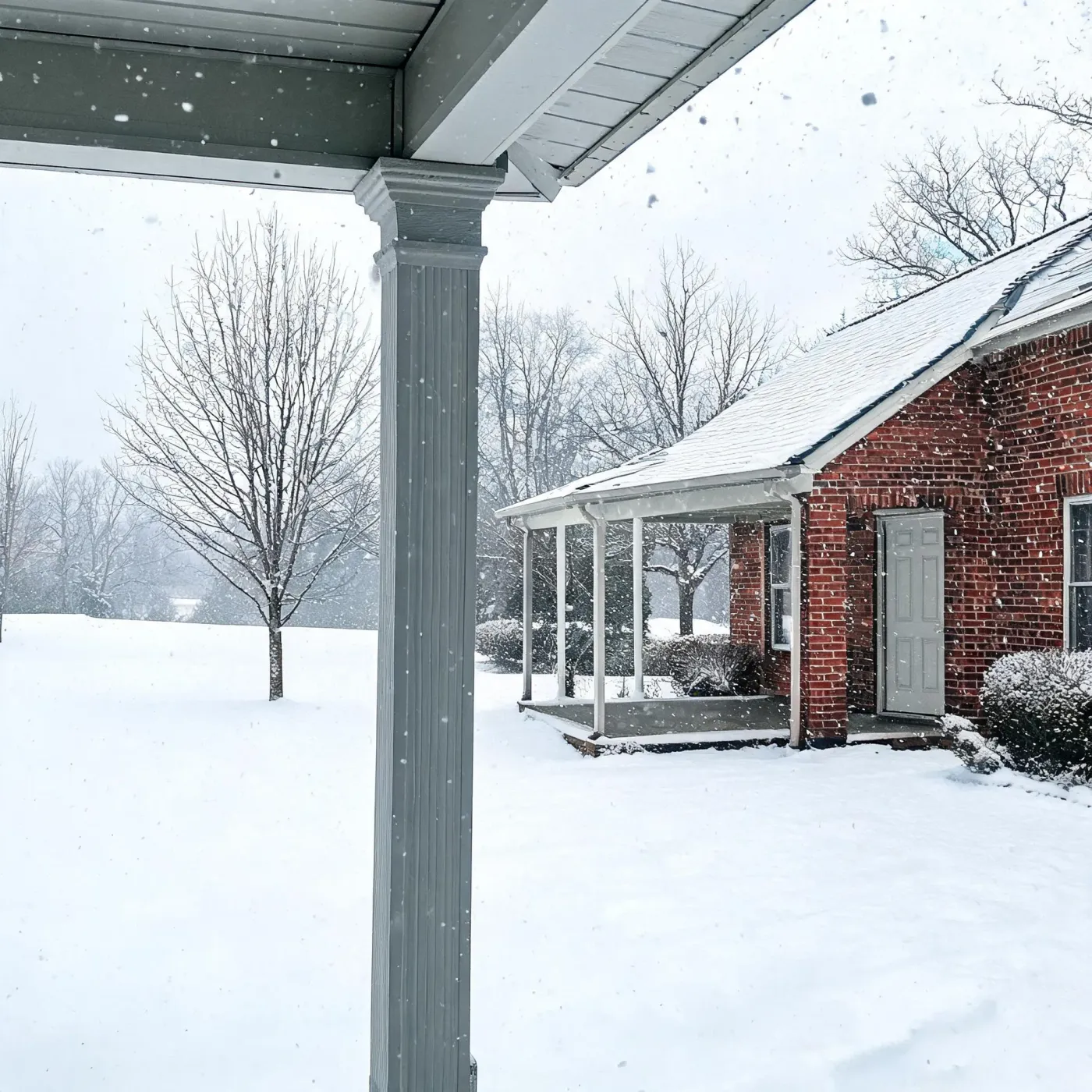
View from under a covered porch with a gray square column toward a red brick house with a white-columned porch and gray door, with falling snow covering the yard, roof, and bare trees.

Winter nights average 26°F across New Jersey, according to NOAA climate data. That's cold enough that your furnace isn't cycling on and off for a few minutes at a time. It's running long stretches, often most of the night, to keep up. A crack in the heat exchanger gets worse the longer the metal stays hot, so those long runs matter. The same nights that make your furnace work hardest are the ones where you're asleep and least likely to notice a smell or a flame that's gone yellow instead of blue. That's part of why catching a crack early, before the cold really sets in, makes a difference.

NOAA nClimDiv 1991-2020 county normals weighted by homes

Can a cracked heat exchanger make you sick without a CO detector going off?

Can a cracked heat exchanger make you sick without a CO detector going off?

Yes. A detector only trips at a certain concentration

A carbon monoxide detector is built to sound an alarm once levels cross a threshold meant to protect you from acute poisoning. A small crack can leak enough exhaust to cause headaches, nausea or fatigue well before it pushes CO that high. That's why the smell, the yellow flame, or soot around the cabinet often show up first. If you're feeling sick only when the furnace is running and better once you leave the house, treat that as real evidence even if the detector stays silent. Place a detector near the furnace itself, not just in bedrooms, since that's closest to where a leak starts.

A gray high-efficiency furnace with two access panels stands in a bare basement corner, connected to sheet-metal ductwork, white PVC vent pipes, and flexible gas and electrical lines.

Waiting it out on your own

If you decide to watch it for a while, that means checking the flame color every time the furnace kicks on, keeping a window cracked when you're down there, and listening for short cycling on top of everything else on your list. Gas furnaces here run long stretches most winter nights, so the checking doesn't stop after one look. Every week you wait is another week the crack has to get worse, and no homeowner can see inside the exchanger to know how far along it is.

A gas furnace with metal ductwork, copper and yellow gas piping stands against a wall in an empty room with a bare concrete floor.

Getting a straight answer

A licensed contractor opens the cabinet, tests the exchanger directly, and tells you in one visit whether it's cracked and what repairing or replacing it involves. You stop guessing from the flame color and the smell. Once you send the form, you're not the one calling around or explaining the symptoms again to a second or third contractor. Someone else is doing that legwork, and you're waiting on an answer instead of chasing one.

A closed silver laptop and a glazed ceramic mug on a wooden table, with a blurred kitchen counter, potted plant, cutting board and window in the background.

A cracked heat exchanger doesn't fix itself

The smell, the flame color, the short cycling, the headaches that ease when you step outside. Any one of those is reason enough to get the furnace looked at before the next cold night. New Jersey winters don't give a cracked exchanger much time to sit quiet. A furnace running long stretches at 26 degrees is a furnace that needs a straight answer, not a guess from across the basement.

Getting that answer usually means finding a contractor who works on furnaces, calling a few, explaining the smell and the flame and the short cycling to each one, then waiting to see who can actually get out there and comparing what they quote. Send the form on this page and that part of it is off your plate. A licensed contractor in your area takes it from here, and you go back to just living in your house while someone who knows furnaces handles the rest.

Interior corner with a beige sofa holding a dark green and a light cushion and a textured throw, a potted small-leaved tree beside a white-framed window, and a dark shallow bowl on a wooden coffee table in the foreground.
A dark wood cabinet with a paneled door and a ceramic pot of green foliage on top stands in a beige-walled room with white baseboard, a window at left, hardwood floor, and a patterned area rug.
A dark wood glass-front cabinet holding folded towels, woven baskets and a ceramic vase stands in a bathroom corner beside a window, with a potted fern and stacked towels on top and a freestanding tub partly visible at left.
A woven basket holding a green cushion and a cream fringed knit throw sits on a wood floor in a room corner beside a window and a dark wooden cabinet.
Corner of a room with a dark wood cabinet topped by a round vase, a linen curtain at a window, white baseboard, oak plank flooring with sunlight patches, and a woven jute rug in the foreground.
A dark wood sideboard against a pale wall holds a shallow stone bowl and a round ceramic vase with leafy branches, with sunlight from a curtained window falling across the wall, wood floor and woven rug.

Done looking for a furnace pro

Describe what your furnace is doing once, in one form.

Hand off my repair

No charge to send it. You decide if you hire them.